A mere nine months ago, my life veered off its anticipated course. I had spent days carefully planning a trip to Florida for Ferrari’s Corso Piloto—a three-day, intensive racing experience led by professional drivers, designed to sharpen my racing techniques. With my bags packed and my departure imminent, my wife intervened. She had something important to share with me before I set off. She held out two positive pregnancy tests, and with a nervous smile, she told me that I was going to be a father.
With the clock ticking down to my flight, I hugged my wife, voiced my happiness, and left our home in a whirl of emotions. As my father and I traveled to Florida, I found myself deep in thought, grappling with the magnitude of the news. The profound shock that I believe envelops all first-time expectant parents had ensnared me. The subsequent three days of high-speed racing provided little respite from my anxiety, although they did offer a momentary distraction. Upon my return home, my life did not revert to its previous pace, as though exiting the fast lane. Instead, it felt like I had shifted into an even higher gear.
A torrent of thoughts swept over me. Was I ready to be a father? What did it mean to be a good father? And what, exactly, was the nature of ‘goodness’? These queries whirled around in my mind, setting me on an urgent pursuit of understanding. After the holiday merriment of that year’s Christmas, the reality truly set in. Our families knew; my wife and I were on the verge of introducing a new life into our world. The next task on our to-do list was to transform a spare room into a nursery, making our home baby-ready.
One quiet afternoon, I stood alone in the bare room destined to become Carlee’s haven. As I surveyed the unmarked walls, paint and brushes within arm’s reach, a powerful metaphor struck me: this room mirrored my life. I had to cleanse myself of negative influences, eliminate those parts of my persona that didn’t align with the man I wanted to be. Most importantly, I needed to take up the metaphorical brush and paint a new portrait of myself onto life’s canvas.
My first step was to gain a deep understanding of morality and its role in my life. Looking back, this was not only the most important but also the most daunting challenge. I found myself needing to conduct a thorough self-analysis, to evaluate my life and actions up until that point. I had to unravel the events that led me to the present to better navigate my future.
In my search for insights to facilitate this transformation, I discovered an influential figure in our cultural dialogue, Dr. Jordan Peterson. His teachings were initially difficult for me to grasp. He preached about the importance of personal responsibility, faith, and the impact of ethical behavior on the world. To achieve this, he suggested, one must confront their past and meticulously sift through their life, separating the valuable from the frivolous. Intrigued by his wisdom, I purchased his book, immersed myself in its contents, and took my first sincere look into my past.
Looking back on my past was an unsettling experience. I came to the realization that I had never seriously examined my character or actions, at least not with a genuine intention to improve. I was not the moral person I had thought; I wasn’t someone I could admire. I couldn’t even claim to have accomplished anything truly significant. This plunged me into a deep introspective abyss. The questions “Who was I, really?” and “How could I raise a child, being fully aware of all my past missteps?” haunted me. Confronting the selfishness, bitterness, lies, and other transgressions I had committed throughout my life was an overwhelming experience. I saw myself in a raw and unfiltered light, as a perpetrator and a sinner. This revelation was more challenging than anything I had previously faced. Yet, staying true to my usual pattern, I kept it to myself. I internalized everything, relying on my long-practiced strategy of sheer willpower to tackle the issue. Looking back now, I see this approach was flawed. My refusal to seek help or guidance wasn’t a virtue, but a shortcoming; my pride, rather than being a tool for self-improvement, only served to hinder my progress.
However, my journey was far from completion. Indeed, I believe it was only when I hit rock bottom that I discovered the key. On a seemingly ordinary Saturday afternoon in March, I chanced upon an unexpected solution: writing. During a podcast, the speaker mentioned a word processor—a space to write without constraints that boasted a myriad of intriguing features. With a two-week free trial on offer, I thought, why not give it a go? I set a modest goal to write daily for 14 days, envisioning it as a personal experiment. In retrospect, I now understand that it wasn’t just coincidence that guided me towards writing; it was a divine intervention.
In that two-week span, I funneled 50,000 words onto the unmarked landscape of a digital page. This exercise reignited a skill I had set aside, having not written anything significant since my college years, almost a decade ago. For the first time, I believe, I found a semblance of order in the chaos of my thoughts. I could wade through the swirling maelstrom of my mind—my queries, reflections, and deficiencies. It was through this introspective journey that I discovered I wasn’t alone in my quest to understand my identity and the individual I was striving to evolve into.
Despite having overlooked religion for years and being absent from church services for nearly two decades, within those two weeks of intense writing, I found myself purchasing a rosary and attending Mass for the first time. During that initial service, I wrestled with doubts and felt the urge to retreat. I distinctly remember sitting there, observing the thinly scattered congregation. I had seated myself in a solitary corner of St. Teresa’s, which hindered my view of the extensive aisle of the church and the assembly seated there. Despite this self-imposed isolation, I steeled my resolve, deciding that I had ventured this far and wouldn’t yield to the temptation to leave.
During that service, the priest spoke from the gospel and it was as if God was speaking directly to me:
John 9:1-11:
“As he went along, he saw a man blind from birth. His disciples asked him, ‘Rabbi, who sinned, this man or his parents, that he was born blind? ‘
‘Neither this man nor his parents sinned,’ said Jesus, ‘but this happened so that the works of God might be displayed in him. As long as it is day, we must do the works of him who sent me. Night is coming, when no one can work. While I am in the world, I am the light of the world. ‘
After saying this, he spit on the ground, made some mud with the saliva, and put it on the man’s eyes. ‘Go,’ he told him, ‘wash in the Pool of Siloam’ (this word means ‘Sent’). So the man went and washed, and came home seeing.
His neighbors and those who had formerly seen him begging asked, ‘Isn’t this the same man who used to sit and beg?’ Some claimed that he was.
Others said, ‘No, he only looks like him.’
But he himself insisted, ‘I am the man.’
‘How then were your eyes opened?’ they asked.
He replied, ‘The man they call Jesus made some mud and put it on my eyes. He told me to go to Siloam and wash. So I went and washed, and then I could see.’”
When he had finished his reading, he spoke the homely to the congregation. These words could have been spoken directly to me:
“It is not for us to determine the mercy and choices of God. It is only though him that we can be made to truly see, and through his infinite mercy that we are saved.”
Tears welled up in my eyes as I took in these words, struck by the sudden awareness of my previous follies. It occurred to me that God didn’t judge me based on my past wrongdoings, but instead on my potential for growth and righteousness. He was not concerned with my historical blunders but my capacity to change course and tread the path of virtue. Even though He was fully aware of my flaws, His love remained steadfast and unswayed by my actions.
As the priest wrapped up his sermon and the congregation readied itself for communion, I found solace in these divine truths. Doubts about my place in this spiritual gathering faded, and I felt the enveloping mercy and grace of Jesus cleanse me. I rose and turned to accept the priest’s blessing, and the congregation came into my sight. Hundreds of souls were there, and I, sitting in the visitor’s section, physically apart yet spiritually intertwined. God had given me a final test of determination, and I had fully embraced His divine message.
Back in the half-painted nursery, I surveyed the unfinished walls once more, brush in hand, prepared to redefine my life. It felt as if a burdensome load had been lifted from my shoulders. My worries and doubts about my readiness to become a father had dissipated. I grasped my responsibilities and came to the understanding that I was never alone in navigating my life or preparing for the future. God was with me, my wife was with me, my family was with me, rendering all my pride and willpower insignificant in contrast. This revelation prompted me to reconnect with my faith and explore further the teachings that God had imparted to the world. I bought a Bible, immersing myself in divine wisdom I had once shunned. I began attending religious discussions and reading more consistently, nurturing the gift of writing that was bestowed upon me.
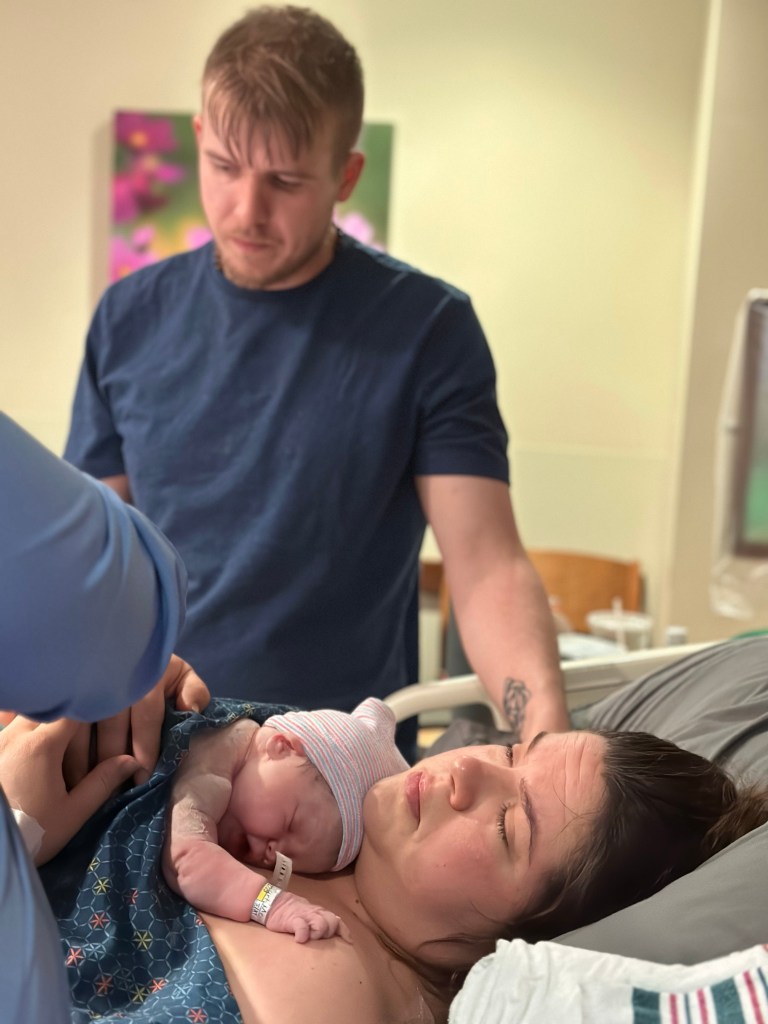
In the closing months of my wife’s pregnancy, when most would be riddled with nerves, I found myself in a state of tranquility, eagerly anticipating the path unfolding before me. I reconnected with a faith group that I had prematurely turned my back on for reasons that now escape my memory. The day my daughter came into this world, I silently prayed the rosary beside my wife, pleading for God’s fortitude, a plea He graciously answered. My daughter was born on May 27th, healthy and beaming with happiness.
Experiencing the miracle of childbirth is beyond words—the surge of emotions, the sense of relief, and the sheer joy. Yet, to me, it represented more than an unforgettable moment. It signified my transformation, led by Christ, into the person He intended me to become. Looking back, I find it strange to admit that I barely recognize the man I was before learning of my impending fatherhood. The name we share is the only remaining tie. I don’t question why God wished for my growth to unfold in this manner, and I am now firmly grounded in the belief that if I continue to heed His word, He will guide me on the path I am destined to tread. The hardship of my life’s pivotal lesson has made me humble before our Creator’s will. All I can offer is my unwavering readiness to accept whatever path He has laid out for me, praying for His strength to guide me as I strive to follow His direction to the best of my capabilities.
 Walt's Blog
Leave a comment