As the world races towards a future dominated by electric vehicles (EVs), it’s crucial to hit the brakes and consider the potential pitfalls of this transition. While EVs promise environmental sustainability, we must not overlook the reliance many people have on traditional vehicles, often serving as more than just a means of transportation. Let’s delve into this through a real-life story.
One afternoon, a foreign exchange student from Korea, studying at Kent State, arrived at my shop. His car, more than a vehicle, was his lifeline, connecting him to his education, his daily life, and his dreams. Seeing it in dire condition was like watching his world teeter on the edge.
After work, I drove him back to his school, three hours away. The next day, I worked tirelessly to restore not just his car, but his connection to his dreams and daily life. This experience underscored the profound impact a car can have on a person’s life
As we unplug the hype around EVs, let’s remember the real-life implications of this transition and ensure it doesn’t leave anyone stranded. This brings us to a changing dynamic in our relationship with our vehicles.
There was a time when substantial repairs on a vehicle with over 150,000 miles would prompt a discussion about whether it’s more prudent to replace it with a newer one. However, these conversations are becoming increasingly rare. More and more owners are choosing to keep their vehicles, regardless of the repair costs. This isn’t just a trend—it’s a shift in how we view and value our vehicles.
As we navigate the transition to EVs, it’s crucial that we acknowledge and address these shifting dynamics. The move to EVs isn’t just about technology or environmental sustainability—it’s about people and their real-world needs.
As policymakers and industry leaders vigorously promote the adoption of Electric Vehicles (EVs) in a bid to address our environmental dilemmas, they run the risk of glossing over the significant implications tied to such a swift transition. This laudable goal of environmental sustainability fails to consider the economic realities many vehicle owners grapple with, especially those who depend heavily on older vehicles. This burgeoning problem in the auto industry is driven forward by those who remain blissfully unconcerned with the fallout from their fervent drive towards their agenda.
Diving deeper into the issue, it becomes clear that Electric Vehicles (EVs) are increasingly hailed as the ‘future’ of the automotive industry. Indeed, a majority of car manufacturers are now making public commitments to transition their entire lineup to EVs by the mid-2030s. On the surface, this goal appears praiseworthy—proponents argue that swapping Internal Combustion Engine (ICE) vehicles for EVs represents a ‘vital move’ towards shrinking our carbon footprint and advancing transportation technology. The media, government officials, and EV devotees alike ardently extol the plethora of advantages linked to this shift, including the eradication of fuel costs, lower maintenance bills, and a new breed of electric models that outpace their ICE equivalents in speed and power.
But is any of that actually true? Under the veneer of progress, this transition harbors potential pitfalls that are frequently obscured. Indeed, government policies and green initiatives, under the guise of noble intentions, may inadvertently exacerbate the already critical issue of customers holding onto their older vehicles. It’s important to remember the serious considerations that come into play—the high price tags on new electric models, the existing constraints in charging infrastructure, and the substantial environmental impact of manufacturing and disposing of EV batteries.
The notion of transforming our automotive landscape into an all-electric future has gained fervor in recent times. But is it genuinely a panacea for our environmental concerns, or is it a well-packaged ideal that glosses over the profound implications lurking beneath? Despite the enthusiasm, electric vehicles are not without their share of pitfalls. The idea of an abrupt, wholesale shift to a fully electric vehicle market is not just impractical but also teeters on the edge of economic feasibility. As it stands, the rush to embrace electric vehicles, while discarding conventional combustion engine vehicles, poses a serious threat to the average American driver.
A recent report from S&P Global throws light on an important trend in American automobile ownership. Out of the 280 million cars currently on the road in the United States, a staggering 74% are at least 12.5 years old, and this figure continues to grow each year. This signifies that Americans are holding onto their vehicles longer, keeping them well beyond their warranty periods. From an auto repair perspective, this creates a significant challenge, particularly for those consumers operating on a tight budget.
One of the fundamental hurdles posed by the shift towards electric vehicles is their heavy reliance on batteries. An undeniable reality with batteries, irrespective of their level of technological advancement, is their gradual loss of charging capacity over time. This fact is often overshadowed by the more immediate benefits of EVs, leaving the long-term domino effects on the automobile market largely unexplored. As we further delve into these repercussions, it becomes increasingly apparent that the consequences of our transition to EVs may not fully materialize until several years down the road.
The Achilles’ Heel of Electric Vehicles
Central to these challenges are Lithium-ion (Li-ion) batteries, a mainstay in the EV world. Their reigning position in the market is not incidental; these batteries boast a superior power density that makes them an attractive proposition for long-range electric cars. But every coin has two sides. This elevated power density comes with a sizeable trade-off: Li-ion batteries undergo accelerated capacity fade with usage and time. This facet of their nature could prove detrimental to the lifespan of EVs, especially when operating in diverse climatic conditions.
In more tangible terms, capacity fade is akin to a battery slowly losing its zest over time. For example, an EV might start with a capacity fade of 100% on a sweltering summer day, which could dwindle to 80% as the temperature rises. But this situation gets complicated on a frigid winter day; that same capacity could drop precipitously from 80% to 40%.
To illustrate, we could compare this to the behavior of an Internal Combustion Engine (ICE) vehicle on a frosty morning. We’re all familiar with how an ICE car feels sluggish—like a wet sponge—after a cold start on a winter day. But once the operating temperature is reached and the engine warms up, the car regains its pep. The difference with EVs? The battery is the equivalent of a 3,000-pound engine that takes hours, not minutes, to warm back up.
Addressing the issue of capacity fade, auto manufacturers have adopted a specific strategy—equipping their EVs with oversized batteries. The intention is to sustain adequate performance throughout the battery’s lifespan, typically projected between 5 to 10 years. This approach might offer a temporary solution to capacity fade, but it also inflates the vehicle’s initial cost, putting it further out of reach for the average American driver.
A further layer of complexity comes into play when we consider that the lifespan of a Li-ion battery isn’t set in stone. Numerous factors such as usage frequency, charging habits, and even environmental conditions significantly influence the battery’s real-world longevity. Predicted lifespans of 5 to 10 years can be undermined by these variables, leading to uncertainty for potential EV owners. This unpredictability becomes all the more significant for those eyeing the used EV market or operating on strict budgets, adding another twist to the multifaceted discussion surrounding EVs.
While strides have been made in battery technology, notably with advancements in Battery Monitoring Systems (BMS) featuring advanced thermal regulation systems, the concern about battery longevity isn’t completely unfounded. Despite the advancements in managing battery health, we cannot escape one undeniable truth – batteries, by their very nature, have a finite lifespan. This inherent limitation must be part of our considerations as we charge ahead in our pursuit of electric vehicle technology.
Manufacturers often present their consumers with assurances that these batteries will last between 8-10 years, reinforced by warranties. However, these guarantees do not mitigate the looming concern of battery replacement. Once these batteries reach the end of their life, their replacement will pose both a logistical and financial challenge that could significantly impact the second-hand car market and its customers as electric vehicles proliferate.
Amid the enthusiastic embrace of Electric Vehicles (EVs), the intricate long-term economic implications and effects on the used car market often remain veiled beneath the shiny exteriors of these machines. These considerations may indeed pack a bigger punch than current discussions surrounding clean energy generally anticipate.
The rapid transition towards EVs, while hailed as a stride towards sustainability, raises serious economic concerns for a significant segment of the population. Specifically, those who rely on the affordability and reliability of used vehicles might find themselves disproportionately burdened.
In fact, this heralded shift to EVs could paradoxically end up backfiring. An unchecked, hasty transition could result in pushing a large portion of the American driving population towards older, less dependable vehicles and inadvertently ramp up associated costs. These potential implications cast a long shadow over the advertised benefits of this new technology and call into question the wisdom of such a swift and comprehensive shift.
An issue of serious concern is the inevitable degradation of batteries. Batteries may be the heart of an EV, powering its operations, but their lifespan isn’t infinite. Over time, their capacity and efficiency dwindle, and they must be replaced. This inevitable obsolescence introduces a potential cost pitfall that may not be immediately apparent to many consumers. The cost of replacing an EV’s battery pack can range from $5,000 to $20,000, a sum that might exceed the vehicle’s value once it has racked up significant mileage. Essentially, this situation could render the EV worthless and destined for the scrapyard far sooner than its Internal Combustion Engine (ICE) counterparts.
This troubling trajectory has implications that extend far beyond the direct financial impact on the EV owner. As an increasing number of EVs reach the end of their lifespan prematurely due to the steep cost of battery replacement, the supply of used cars in the market begins to dwindle. This reduction delivers a sharp blow to those on tighter budgets, who often depend on the affordability and availability of used vehicles. With the supply diminishing while demand remains steady or potentially even rises, market dynamics could become unfavorable, driving up the prices of used cars. Such a shift could trigger a significant disruption that could impact the average American driver’s access to affordable transportation, a fact that we simply cannot ignore.
The severity of this issue is strikingly clear when we examine the example of the Nissan Leaf. Launched over a decade ago, this EV came with an appealing initial price tag of $30,000. However, as the 8-year or 100,000-mile warranty period expires, the reality starts to hit. The burden of replacing the battery—a cost that can range from $7,000 to $12,000—falls on the owner. This considerable outlay forms a significant hurdle in the used EV market, effectively discouraging budget-conscious consumers from viewing these vehicles as a viable option.
For a comparative analysis, let’s consider one of the most common ICE sedans in the U.S. today, the Toyota Camry. We’ll examine factors like the cost of maintenance over time and the residual value of the vehicle as it ages. One of the frequent assertions made by advocates of the EV market is that these vehicles require minimal maintenance and will, therefore, ‘save money’ compared to traditional ICE cars. But is this assertion accurate? Let’s delve into this by focusing on a comparison between the Leaf and the Camry.

Upon examining the facts, it becomes starkly apparent that the long-term cost of maintaining a Leaf significantly surpasses that of its ICE counterpart, the Camry. This observation doesn’t even take into account other well-known challenges of electric vehicles, such as limited driving range and long charging times. However, this simple cost comparison doesn’t fully capture the long-term ripple effects we’ve discussed earlier. For a more profound understanding, we need to scrutinize the value retention of these vehicles over time and with increasing mileage. Kelly Blue Book, one of the most trusted names in vehicle evaluation, makes this comparison straightforward:
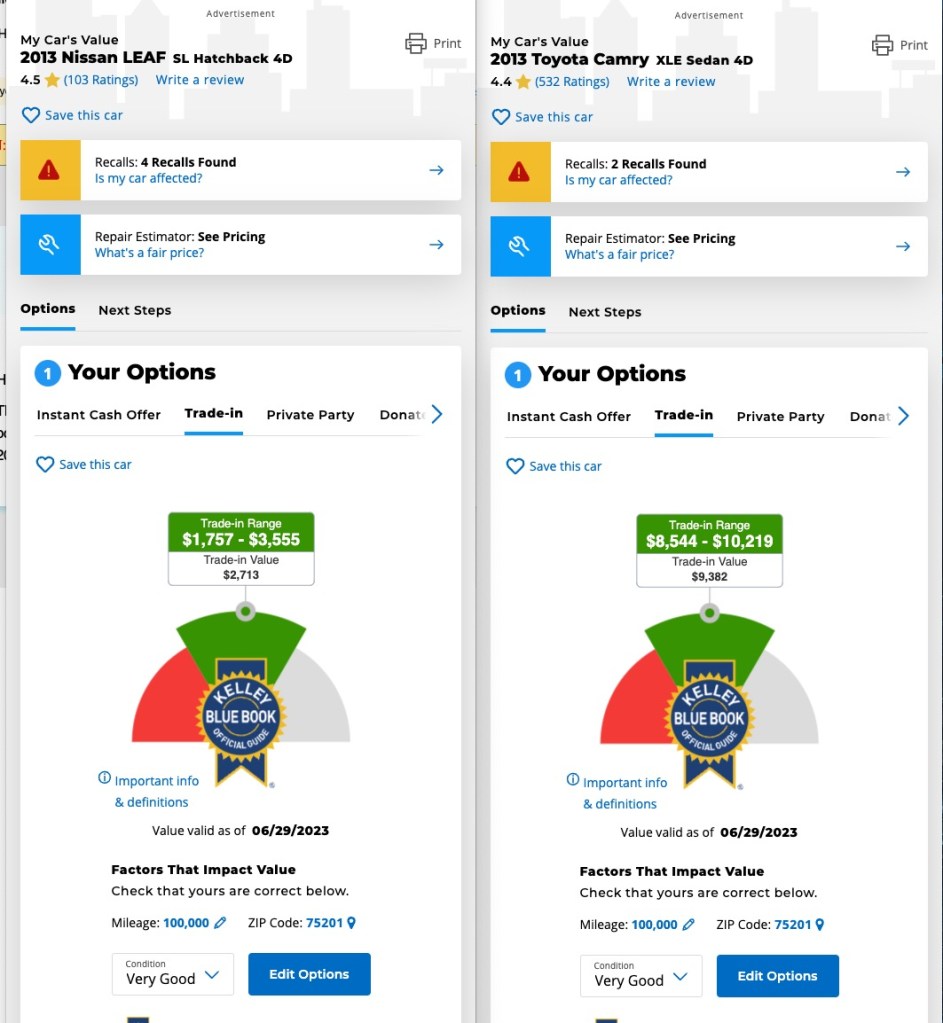
It’s alarmingly clear from this single comparison that an EV’s value drops well below the cost of battery replacement after a certain age. As a result, an electric vehicle essentially becomes a disposable commodity, further complicating matters for the used car market and the average American driver. But the problem we’re staring at here isn’t confined to economic metrics—it reverberates across societal dimensions as well.
The harsh reality is that potential owners looking in the $5,000-$10,000 price bracket are unlikely to take on the gamble of an EV, especially given the possible hidden cost of a $10,000 battery replacement lurking in the background. And what is the fallout? These buyers may find themselves with no alternative but to stick with their older, higher-emission vehicles. This predicament traps them in a cycle of never-ending repair costs and accompanying stress, intensifying the financial burdens they’re already grappling with.
The rapid and thoughtless shift toward electric vehicles presents an alarming threat to the auto repair industry, an industry primarily built around servicing internal combustion engine (ICE) vehicles. This trend is not just problematic; it’s creating a ticking time bomb that could leave the American driver in a precarious position.
The auto repair industry is already wrestling with a substantial shortage of skilled mechanics to service the vast fleet of ICE vehicles that currently dominate American roads. As the precipitous shift towards EVs continues, every EV reaching its end of life and being hauled to the scrapyard removes another used vehicle from the market. This, in turn, results in more and more people bringing increasingly older vehicles in for maintenance.
The inevitable result? An overloaded system, with fewer and fewer technicians left to handle the mounting maintenance needs of the ever-aging fleet of ICE vehicles. This translates directly into longer wait times for repairs, a decline in service quality, and – most worryingly – a steep increase in repair costs. And who will bear the brunt of this impending crisis? The American driver, left stranded by the roadside as their repair bills soar.
This impending crisis is an immediate byproduct of the headlong rush towards EVs. This transition, despite its touted benefits, overlooks the wider implications on the auto repair industry, and more importantly, the American driver. The relentless pursuit of an all-electric future risks leaving a significant segment of the industry—and the public—in the rearview mirror. The need to reevaluate the potential pitfalls of this transition is urgent, before the typical American driver is burdened with a hefty bill.
These potential complications only magnify the risks for consumers, particularly those in lower income brackets. If the costs of maintaining and repairing EVs surge, these consumers could find themselves faced with a shrinking pool of affordable vehicle options. This could inadvertently force them to retain their older, and increasingly costly-to-maintain vehicles.
The blind enthusiasm surrounding Electric Vehicles (EVs) is nothing short of a well-orchestrated farce, cleverly diverting our attention from the colossal socioeconomic disaster that lurks in the shadows. As we dive deeper into this mess, the true cost of these so-called ‘green machines’ becomes startlingly clear. Exorbitant purchase prices, staggering battery replacement expenses, a vanishing supply of affordable second-hand vehicles, and a looming crisis in vehicle maintenance underscore a narrative that’s being conveniently ignored in the deafening chorus of EV glorification.
The cruelest irony of this fiasco? The brunt of this ill-planned transition is shouldered by those least equipped to bear it. The ‘saving the planet’ rhetoric is turning out to be a thinly veiled ruse to push an agenda that is blatantly disregarding the broader socioeconomic implications. It is rapidly turning the automotive industry into an exclusionary club, accessible only to those fortunate enough to afford the membership fee.
We’re racing down a path of no return, charging headlong into a future where mobility is no longer a common right, but an exclusive privilege. It’s time we hit the brakes, reassessed our direction, and dared to explore different routes. We must seek solutions that balance our environmental responsibilities with economic viability, instead of propelling us toward a future punctuated by deeper socioeconomic disparities.
The EV craze needs a reality check. We need to steer the narrative away from this foolhardy path and toward a more reliable, affordable, and practical solution. The ‘green’ future we’re being sold isn’t all it’s cracked up to be—it’s a ticking time bomb that threatens to blow a gaping hole in long standing archetype that is the American Driver.
Our relentless pursuit of electric vehicles is, without a doubt, causing an alarming upheaval in our society. This shift is far from an egalitarian revolution in transportation; rather, it’s emerging as a perverse luxury, accessible only to the wealthy few. In our scramble for a cleaner environment, we’re conveniently sidestepping an inconvenient truth: our push for progress is leaving the average American without a car.
The focus on electric vehicles is beginning to look less like a solution and more like an economic stumbling block. As the world leaps to embrace the supposed dawn of a new era in transportation, we run the risk of deepening socio-economic divisions, placing an undue burden on those least equipped to cope. There’s an unjust irony in the promise of a ‘green’ future if it’s only available to the select few who can afford to buy into it.
Sure, it’s easy to get caught up in the electric vehicle hype—the marvels of battery technology, the promises of a cleaner environment, the glamour of accelerating from 0 to 60 in record time. But beneath the shiny veneer and the enticing promise of progress, the relentless push towards EVs is precipitating an impending crisis that isn’t even being discussed.
In essence, our blind race towards EVs is setting us up for a grim reality. A large swathe of American citizens, particularly those who depend on older, affordable vehicles, may find themselves compelled to cling onto their ageing and potentially less reliable ICE vehicles. This could bring about a spike in demand for repair services, further straining the auto repair industry and inevitably hiking up the cost of repairs. This economic ripple effect could exacerbate the financial struggles of low-income Americans, who often rely on these older vehicles to meet their everyday transport needs.
Additionally, this transition risks incubating an even more covert issue—deepening social divisions within lower-income communities. The considerable costs affiliated with EV ownership, such as the high initial acquisition cost, the impending threat of battery replacement expenses, and the potential rise in repair costs, coalesce into a cumulative financial burden over time. This cost cannot be conveniently ignored, mesmerized by the allure of a supposedly eco-friendly future. We must peel back the veneer of environmental optimism to expose the stark reality underneath: Electric Vehicles, due to their ephemeral nature, will ultimately end up in the scrap yard.
This stark realization ushers in a sobering understanding. The era where economically disadvantaged individuals could count on the affordability and endurance of a well-used car—a ‘beater’—for several years’ worth of work commutes, or continuously operate a vehicle with a glowing check engine light, confident it would still reliably complete the trip to the grocery store and back, may be nearing its end. Concurrently, the days of auto mechanics serving as allies to customers with their aging vehicles, those on tight budgets such as the exchange student I once helped get home, offering them budget-appropriate repair options, are also under threat.
Our ambitious pursuit of an environmentally sustainable transport system, driven largely by the allure of EVs, may inadvertently eclipse these critical, practical lifelines of financially strained individuals, potentially shaping a future that is less understanding and inclusive of their predicaments.
Currently, our single-minded quest for environmental sustainability in transportation seems to suffer from a certain degree of tunnel vision. It’s time we shift our focus from the dazzling promise of new EVs and explore a wider spectrum of options. Encouraging the adoption of high-efficiency ICE vehicles and hybrids could provide a more immediate and pragmatic solution for all. These vehicles offer a balanced approach, augmenting our environmental stewardship without compromising economic feasibility, especially for those in the lower-income spectrum.
Rather than pushing for a blanket shift to EVs, we need to focus on a more balanced approach that accounts for the diverse economic realities of the American population. We must strive to find a sustainable solution that does not disproportionately affect those less able to shoulder the cost of this transition. After all, the goal of environmental sustainability should not come at the expense of economic sustainability for the average American motorist.
These alternatives can serve as crucial stepping stones, providing a transitional bridge as we navigate this period until EV technology matures into something more affordable and enduring. By broadening our focus to encompass this larger perspective, we can ensure our progress towards the future isn’t a blind race towards a superficially greener image. Instead, it should be a deliberate, thoughtful journey towards a future that genuinely takes into account and accommodates the diverse socio-economic demographics. It may not be the most glamorous or headline-grabbing path, but it is the sensible, responsible route towards a future that is truly sustainable—both environmentally and economically.
The current momentum behind EVs risks thrusting us headfirst into an illusory green utopia, turning the quintessential American family car into an unaffordable luxury. We need to pause and reassess our trajectory, acknowledging the stark realities faced by everyday Americans who might end up shouldering the consequences of this transition. The aspiration for a ‘green’ future must be critically evaluated in the light of economic practicality and the accessibility requirements of all American motorists. It’s time to slow down and carefully steer our course, ensuring that our push for environmental sustainability does not precipitate economic instability for those already facing financial hardship.



 Walt's Blog
Leave a reply to Robert Marshall Cancel reply